A long time ago, a legend took root in the Dordogne, France. In times of need and desperation, people always sought to look up and maintain hope – hope for a better future and hope for safety. Allow me to share a story of that hope, which was held by the ancient inhabitants of our village, long before our time.
The village of Pontours, named after the tower bridge that once stood, was, for many decades, a dreaded obstacle for merchants and travelers alike. To venture south, one had to cross the formidable Dordogne River, with Pontours and Lalinde offering two of the few shallow crossings. Despite appearing deceptively safe with its clear bottom, many attempted to traverse it by foot or boat. However, the current, already strong, used to be even more relentless, claiming the lives of hundreds. Boats would capsize, taking their passengers with them, while others would succumb to the rushing waters, unable to fight against the force. But was it solely the swift river causing such tragedies, or were the haunting tales told to children at bedtime also to blame? Could there truly have been something or someone lurking in the shallow depths of the River Dordogne?
As the legend goes, there was a cave high above the cliffs of the river where a serpent, a water dragon, or an atrocity of an unearthly reptile was living. Some people described it with fangs, vicious reptilian eyes, a skin made of armored scales, and wings – it was the most frightening thing, the Coulobre, as they called it. It kidnapped people and drew animals into its lair to devour them, leaving nothing but bones behind. The villagers were desperate and didn’t know what to do; the future looked bleak. However, where there is hope, there is a way. One brave villager took it upon himself to journey to Perigeux, the capital of the Perigord, to seek the help of a bishop.
This bishop’s name was Sir Front and he chose according to one legend violence to defeat the water dragon. He lured him with great speech out of his lair and the Coulobre appeared in front of him. He shot him, fearlessly with a bow and an arrow with fire, till the excruciating pain caused the dragon to lose his balance and plunge into the river. Another legend is that with a special sword, he was killed and Sir Front blew the last thrust into the heart of the beast before his ending. (A few different stories are told about the ending but these are the most spectacular ones). The dragon, according to this lore fell back into the waters where he roamed and killed so many and it is said that in summer when the water in the Dordogne River is very low, you could see his fossilized vertebra on the bottom of the river. But some will only see boulders or big rocks…
To thank the great Sir Front for his effort and his bravery, the people built a chapel on the steep cliff that overlooks the Dordogne River and the village of Lalinde. Bishop Front was after this known as the Holy Front or Saint Front. The little chapel got his name, as well as the next village direction Bergerac, Couze et St. Front. The chapel can still be visited and stands tall with its intriguing history in a beautiful green mossed environment. In the summer there is a Coulobre festival and you will find from time to time artwork around Lalinde in the form of a dragon. Also on the market square in Lalinde is a bustling restaurant since 1970 named after this creature.
Some people believe that long ago, St. Front didn’t kill the Coulobre. Instead, it’s said that he used his willpower to make the Coulobre stay away from human lands. The Coulobre supposedly went west and was last spotted heading towards the ocean. Legends say that the creature is now waiting for a chance to seek revenge and emerge from the depths of the Dordogne River again.
Sometimes we feel completely closed off from the world here in the southwestern part of France. January is the month of – 50 Shades of Grey -. Some complain about it, but I love it. I think there is a reason why nature takes a nap when it’s cold and boring outside. It needs rest after that really busy season of hot summer that rolls in the beautiful long season of autumn. There are no 3 months straight spring, summer, autumn, or winter. And here in the forgotten world of January and the Dordogne, there is just a small nook that is registered for winter. Yes, it snows. And yes, it’s definitely cold, especially at night. But no other homecoming to the Dordogne than sniffing those smells like a haunting dog on a Sunday; all those roaring wood stoves and fireplaces with burning French oak.
If you arrive in the dark, you feel like Elon Musk built a Starfleet to Mars and you missed that ship. There will be no life -other than crossing deer, badgers, and foxes, that also had no desire to leave planet Earth-, and there will be no light; all shutters, blinds, curtains, everything that can cover up the proof of life is hidden. No sound; French people tend to stay at home in the winter evenings, drinking their homemade red wines. No terrace is occupied, and most of the restaurants have also adjusted to the hibernation of men and closed for the season. The rolling fog, coming from the Dordogne River or the Vezere when the water is warmer than the outside temperature takes over the outer banks, the valleys, and will climb up onto the hills. Leaving every sound dampened. And the world is silent.
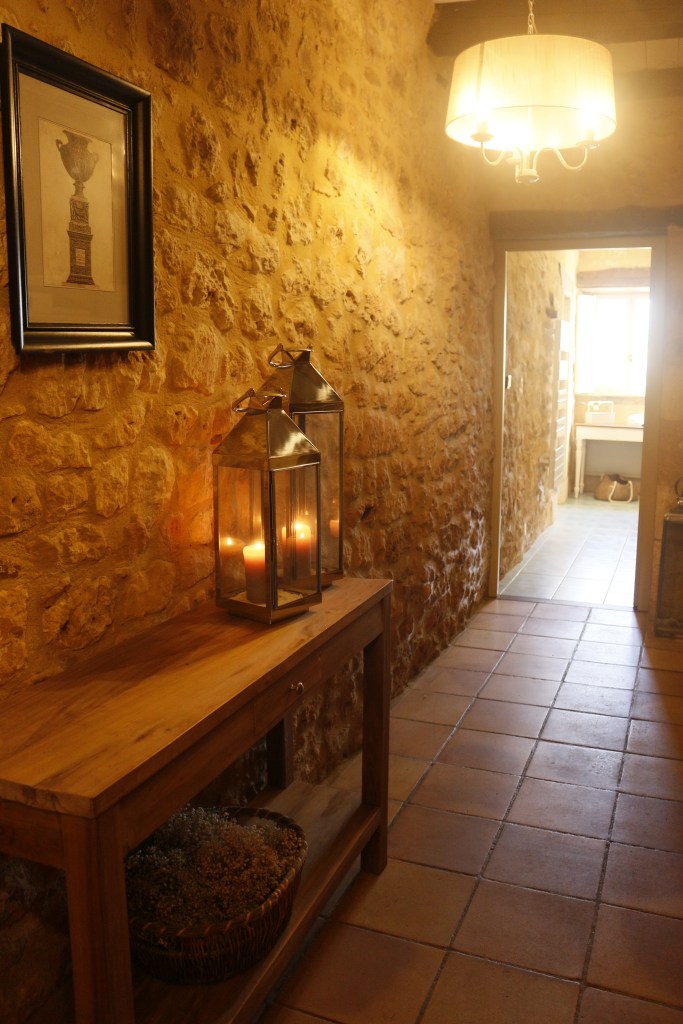
In the morning when the world decides it’s time for a beautiful day, the sun will come out late. And after a frosty night, it can only be described as magical. Driving down the hill, direction the artist of bread and croissants in the nearby village, the river is waking up. The fog will leave the trees covered in a white breakable coat against a blue sky. Stepping into the bakery I am first in line because there are no tourists and well, the rest of the inhabitants also crawled back under the rock where their ancestors the Cromagnon came from, ages ago. They also survived winter. In their caves. With a fire to keep them warm. Nothing has changed much. We still live in, under, and in between stone walls. We changed however the open fireplace into a more efficient wood burner. I still gather wood daily, also no change there.
So if you ever decide to come to this part of the world. This gentle side of life, in winter, in our 50 Shades of Grey. Be prepared for some true peace and quiet. Smell the Dordogne fog, enjoy those calm wind-free days and drink that red wine in front of that roaring, but contained fire. Have a walk in the mossy green forests and don’t forget to bring a camera. It’s easy to survive winter, just embrace the slow steps in this nook of the year. This is how you survive winter in the Dordogne

 -LA MAISON LOUVERIE-